Eastern Switzerland data centre: Sustainable solution with free and adiabatic cooling from Hoval
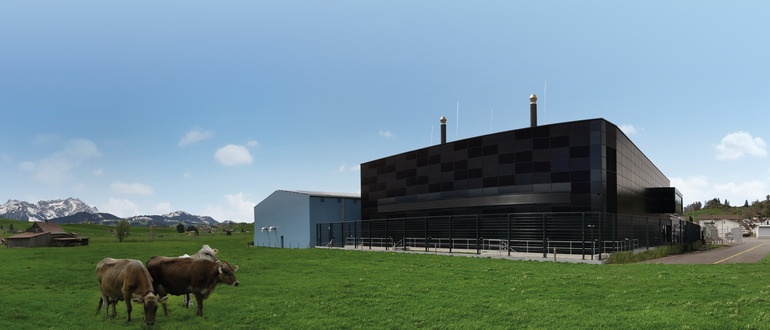
RZO AG operates not only the most secure, but also the most energy-efficient data center in the region in Gais. For cooling the sensitive IT infrastructure, the company relies on a solution from Hoval.
- Data centre
- New Building
In the middle of the Appenzell region, a black, cube-shaped building sets a contrasting accent to the picturesque backdrop of the landscape. On an area of 900 m2, the Eastern Switzerland Data Centre (RZO) offers companies, public institutions and service companies the opportunity to outsource their IT infrastructure to competent hands. With an availability of 99.998%, the RZO complies with the Uptime Institute's Tier 4 classification, which is considered the gold standard in data center availability. Anyone who enters the premises soon gets to know the comprehensive security concept: continuous video surveillance, biometric access monitoring and a personnel gate ensure that the data center resembles a strictly controlled data vault.
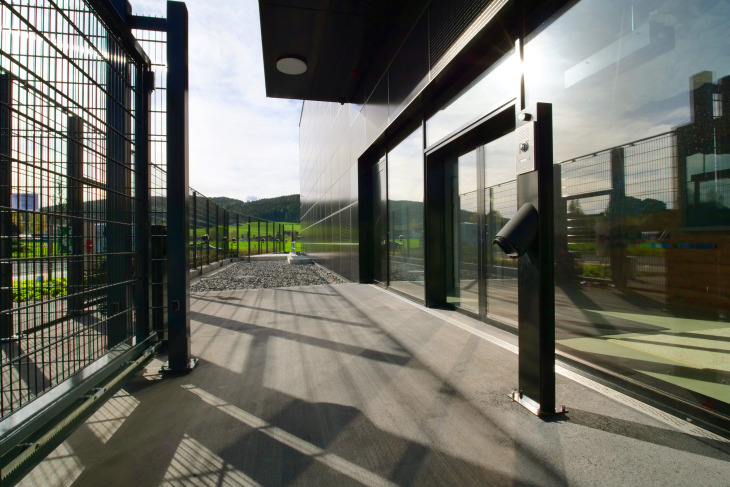
RZO AG operates not only the most secure, but also the most energy-efficient data center in the region in Gais.
Protection of sensitive IT components
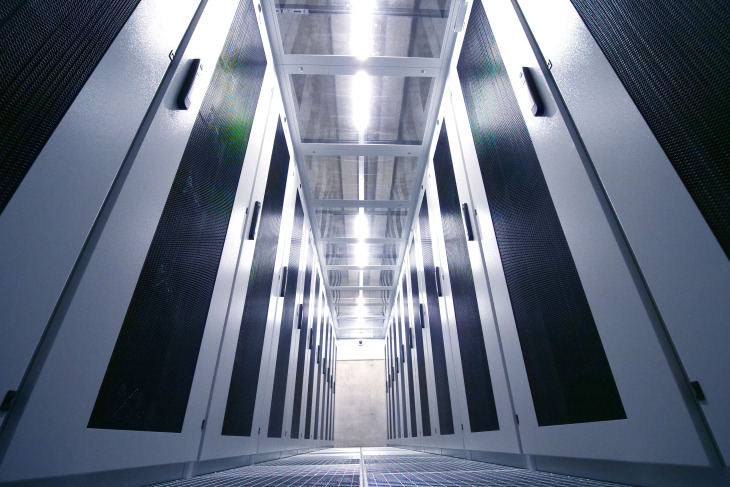
Only Hoval has met our requirements to use the principle of free cooling all year round.
Adiabatic cooling using rainwater
Minimum space requirement, maximum flexibility
Sustainability at all levels
The use of waste heat can save around 1,500,000 kWh annually – this corresponds to around 70,000 m³ of natural gas or 360,000 kg of CO2.
Convincing control and service
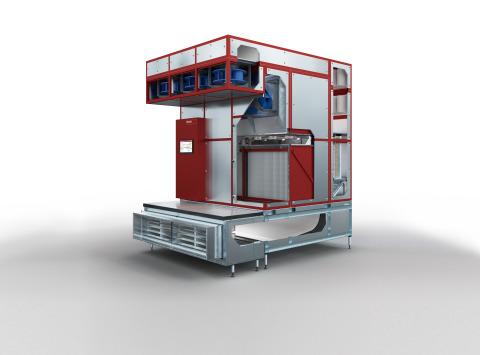
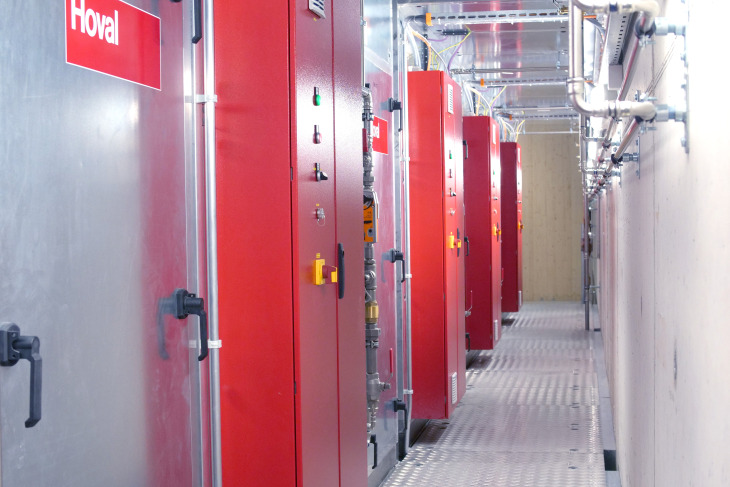
Each of the installed ServeCool devices carries the control system necessary for operation. "Thanks to the graphical user interface – GUI for short – I can keep an eye on the cooling in the data center at all times, even via my web browser. I like the fact that the visualization is simple and intuitive to use," says Jan Isenegger, emphasizing the user-friendliness. And you also feel that you are in good hands with Hoval when it comes to ongoing support. "It turns out that the ServeCool devices are not only energy-efficient, but also low-maintenance and service-friendly, because the components are easily accessible," says Jan Isenegger, and he sums up: "Our solution for free and adiabatic cooling is stable and my contact persons at Hoval are always there for me if I have any questions."
Photo credit: Rechenzentrum Ostschweiz